


The Louvre’s Department of Near Eastern Antiquities is hosting ten major works from New York’s Metropolitan Museum of Art, whose Department of Ancient Near Eastern Art is currently closed for renovation.
The Louvre and The Met have created a unique dialogue between these two collections, which will be displayed in the Louvre’s permanent galleries.
These ‘special guest’ artworks from the Met, dating from between the late 4th millennium BC and the 5th century AD, show some remarkable connections with the Louvre’s collection. In some cases, a pair of objects will be reunited for the first time, while in others, pieces will complement each other by virtue of specific historical features of their respective collections.
Representing Central Asia, Syria, Iran and Mesopotamia, this dialogue between collections and works of art will (re)introduce visitors to these extraordinary, age-old artefacts and the stories they tell.
A joint project coordinated by:
Ariane Thomas, Director of the Department of Near Eastern Antiquities, Musée du Louvre and Vincent Blanchard, curator at the Department of Near Eastern Antiquities, Musée du Louvre.
AN INTERVIEW WITH THE DIRECTORS OF TWO DEPARTMENTS OF NEAR EASTERN ANTIQUITIES
Kim Benzel, Curator in Charge of the Department of Ancient Near Eastern Art, Metropolitan Museum of Art and Ariane Thomas, Director of the Department of Near Eastern Antiquities, Musée du Louvre.
- How did this project come to be, and how did you choose the artworks to be displayed?
Kim Benzel:
The project was born out of the close relationship between our two museums and two departments, which allows us to be in frequent dialogue with one another. The closing of our galleries in New York for renovation presented us with the opportunity to lend these works to our sister institution, the Louvre.
Ariane Thomas:
Our privileged relationship with our colleagues from The Met has allowed us to turn the closing of their galleries for renovation into an unprecedented opportunity for dialogue between precious, unique works of art from The Met and the Louvre. The Louvre’s collection contains many works originating from excavations that add further context to The Met’s pieces. Works from the Louvre and from The Met thus complement each other, working together to offer a clearer picture of the ancient Near Eastern cultures from which they were issued.
- Did the dialogue between these works result in new discoveries? What scientific advances did the meeting of these two collections permit?
Ariane Thomas:
The meeting of our collections was in itself the source of many (re)discoveries for each of the works which entered into dialogue. For example, a fragmentary piece held by the Louvre, which originated from excavations in Tello, Mesopotamia, has allowed for the geographic attribution and dating of a head acquired by The Met, a task which had up until now proved difficult. The Met’s piece has, in return, led to better understanding of where the Louvre’s fragment would have fit into a larger work.
Moreover, a group of objects, long believed to be a necklace, is now on display at the Louvre as a full set thanks to our Met colleagues. This set includes not only pendants but also a number of items which we now believe were excavated together, part of what may have been a monetary hoard.
- Do you have any other collaborations or joint initiatives in the offing?
Kim Benzel and Ariane Thomas:
We plan to press on with our many collaborative projects, and hope that this particular initiative inspires many more exchanges, extending our dialogue into the future.
EXHIBITION ROUTE
Head of a ruler with turban (room 228)
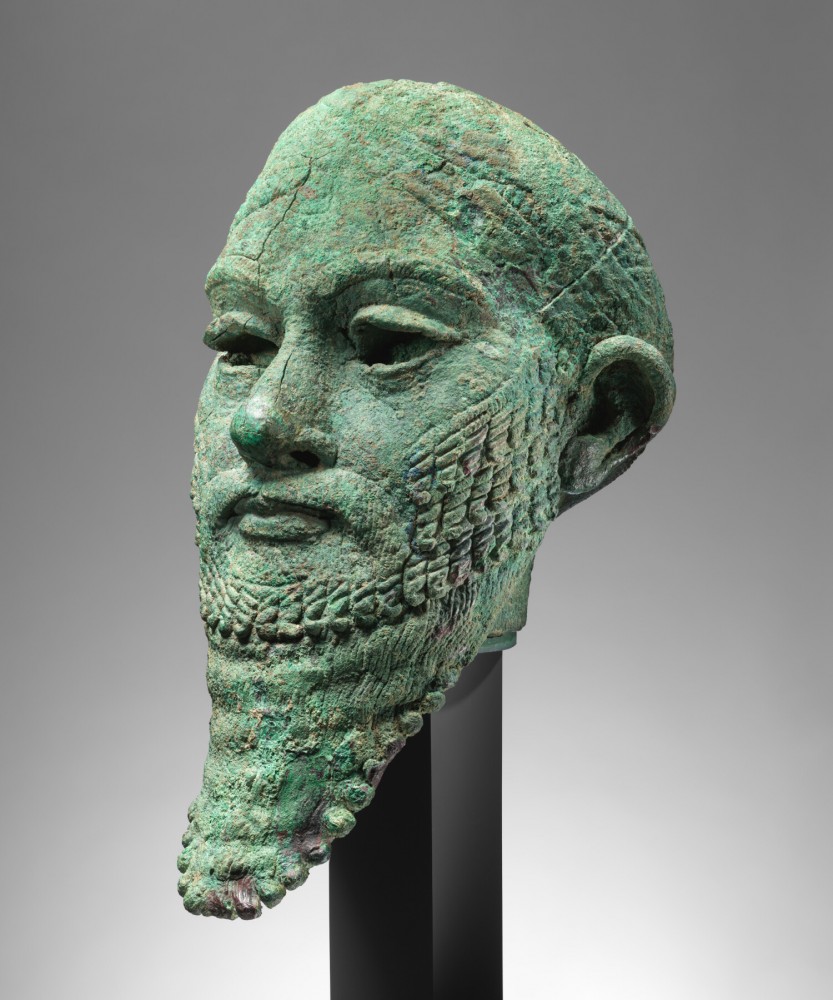
Head of a ruler with turban
Mesopotamia, about 2190–2150 BC
Department of Ancient Near Eastern Art. The MET © The Metropolitan Museum of Art, New York
One of the last remaining vestiges of large copper alloy statuary, The Met’s ‘Head of a ruler with turban’ is remarkable both due to the material used in its creation and the quality of execution. The life-sized head with realistic facial features likely represents a prince; unless they had a symbolic function, the full lips and the prominent nose and ears, uncharacteristic of Mesopotamia, may indicate an ethnicity from lands further east.
Due to the originality of the turban and the quantity of metal used for the casting, it was long thought that this head came from western Iran, a region rich in copper.
However, a stone turban fragment found during excavations at Tello (Mesopotamia) and now held at the Louvre reopened the debate, evoking the close ties between the two regions. The stone fragment, clearly dating from around the 22nd century BC, was also instrumental in dating the copper head more accurately.
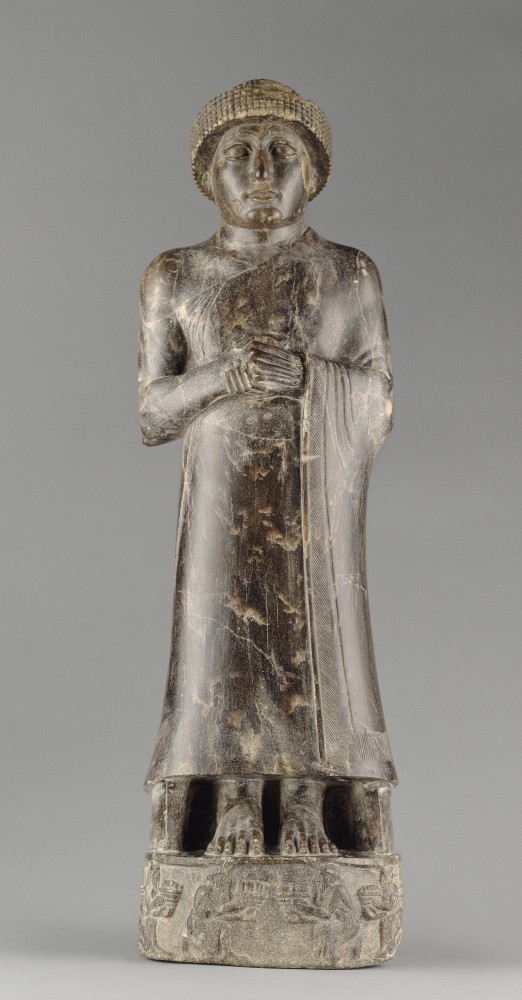
Statue of Ur-Ningirsu. Girsu
Mesopotamia (modern-day Tello, Iraq), about 2210–2105 BC
(Body) Department of Near Eastern Antiquities. Musée du Louvre © 2005 RMN-Grand Palais (musée du Louvre) / Franck Raux
(Head) Department of Ancient Near Eastern Art. The MET © The Metropolitan Museum of Art, New York
The head is shown alongside the statuette of the prince Ur-Ningirsu II of Lagash, a piece shared between the Louvre (body) and the Metropolitan Museum of Art (head), and exhibited in Paris until the reopening of The Met’s rooms.
Other figures in this room feature a different type of royal headdress: a skullcap, such as the one worn by Ur-Ningirsu as well as those seen in the many depictions of his father Gudea – both rulers of Girsu (modern-day Tello).
Kneeling Bull holding a spouted vessel (room 232)
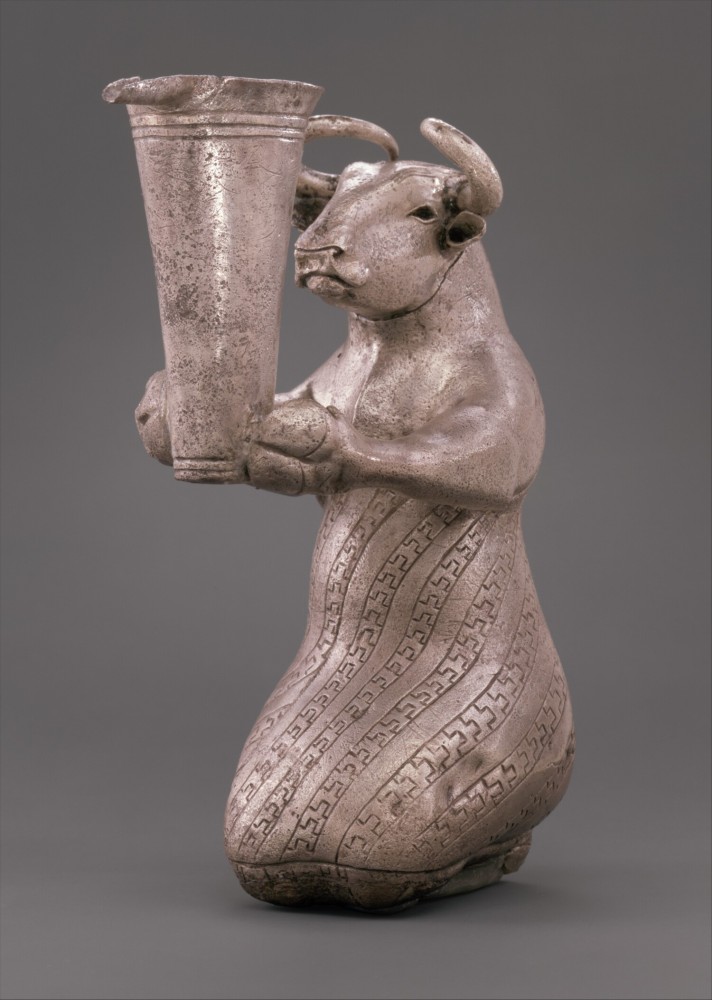
Kneeling bull holding a spouted vessel
Southwestern Iran, about 3200–3000 BC
Department of Ancient Near Eastern Art. The MET © The Metropolitan Museum of Art, New York
This silver statuette depicts a wild ox, common in Iran during this period. The use of silver and the technique employed illustrate the talents of Iranian metalworkers in the late 4th millennia BC. This object also attests to the originality of the art of the Proto-Elamite era (3300–3000 BC), in which scenes of everyday life feature animals rather than humans. Here, the wild bull is kneeling, clothed in a robe and holding a vessel between its hooves, a common posture of worship. This position also echoes that of several orants (figures in prayer) from an earlier period, exhibited in display case 3 of this room. Filled with pebbles, the wild ox is understood to be a noise-making instrument used in worship rituals. It may thus attest to little-known ritual practices from Proto-Elamite Iran.
A parallel can be drawn between the work loaned by The Met and two slightly earlier sculptures discovered in Susa: Small alabaster statuettes depicting orants (figures in prayer). The male figure is seated, holding a vessel before him; the female figure is kneeling. Discovered in ritual deposits, the two pieces refer to practices common to offering ceremonies at the time.
EXHIBITION ALBUM
A joint publication edited by Ariane Thomas, Director of the Department of Near Eastern Antiquities and Hélène Le Meaux, curator at the Department of Near Eastern Antiquities, Musée du Louvre.
Co-published by Musée du Louvre Éditions and Éditions Khéops. Bilingual (French and English).
Format: 24 x 27 cm, 72 pages, 50 ill. Price: €12