


頃 東京都江戸東京博物館蔵_1.jpg)
The First National Bank of Japan, ca.1872-1880, Collection of the Tokyo Metropolitan Edo-Tokyo Museum
This special exhibition will showcase over 200 artifacts related to the Western-style architecture that adorned Meiji-era Tokyo.
During the 55-day exhibition, visitors will be able to experience the spirit of the Westernization movement that captivated the people of Tokyo in that era!
Over 1,000 years after the establishment of Hōryū-ji Temple, which is widely regarded as marking the beginning of Japanese architectural history, the country entered the Meiji era. This transition from the Edo period to Meiji era signaled Japan’s opening to Western culture after a prolonged period of isolation, leading to a sudden influx of Western-style architecture. This resulted in a revolutionary transformation of Japanese architecture, creating a new landscape that inspired wonder and excitement. This exhibition showcases a diverse range of works and items, as well as dynamic three-dimensional display techniques to present the world of Western-style buildings during the Meiji era, when people harbored dreams for architecture.
Once the Meiji era began, the demand for Western-style architecture in Japan grew due to its central role in the new government’s Westernization policy and its embodiment of a new era. At the beginning of the era, knowledge of and experience with Western-style architecture were scarce, and the architectural profession had yet to become established in Japan. However, through the active adoption of Western techniques, the industry underwent a transformation, culminating in the emergence of authentic Western-style architectural structures designed by Japanese architects by the late Meiji era. During this time, many unique Japanese buildings blending Japanese and Western elements were also constructed. Furthermore, a number of national projects were undertaken in the Tokyo to create a capital city befitting a modern nation. Western-style architecture breathed new life into the Japanese urban landscape, producing new landmarks that have captivated people over the years.
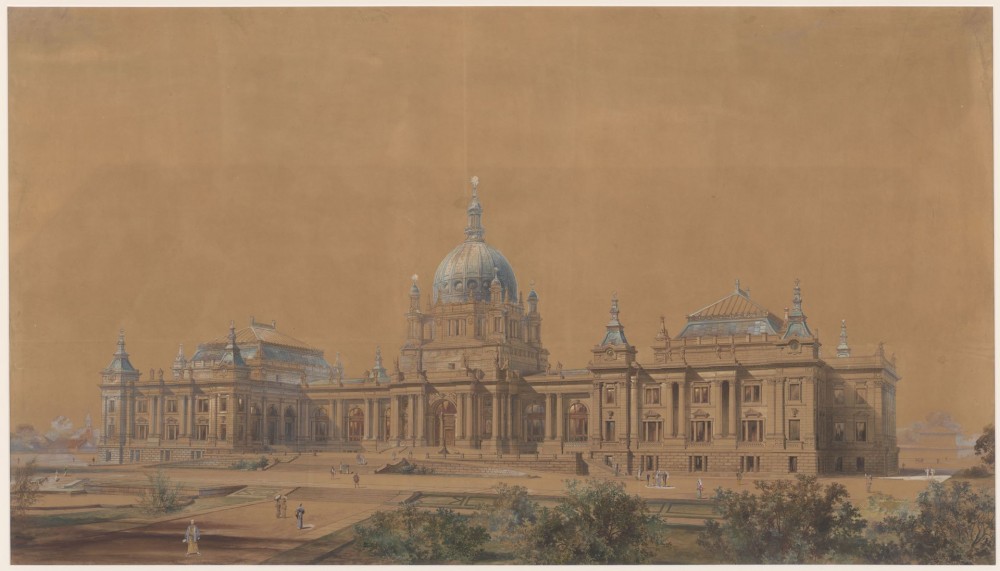
Perspective Drawing of the Proposed Imperial Diet Building Japanese Parliament, Ende & Böckmann, ca.1887-8, Collection of the Technical University of Berlin Architecture Museum Architekturmuseum der Technischen Universität Berlin, Inv. Nr.20190
This exhibition explores the rapid development and spread of Western-style architecture in Meiji-era Tokyo. It also traces the evolution of this style from its initial adoption to the establishment of authentic Japanese Western-style architecture. We begin with pseudo-Western-style (giyōfū) buildings created by master carpenters and then progress to non-authentic Western-style buildings designed by foreign engineers, and authentic Western-style mansions designed by foreign architects. Following that, we examine the challenges undertaken by graduates from the Imperial College of Engineering, and the grand mansions built for the imperial family and the aristocracy. The exhibition vividly captures the diverse achievements of this era of radical transformation, a rare occurrence in the history of Japanese architecture. Furthermore, by showcasing National Treasures, Important Cultural Properties, and works being exhibited in Japan for the first time, as well as threedimensional spatial design, the exhibition attempts to recreate the sense of wonder experienced by the citizens of Tokyo at that time. Please come and experience the spirit of the Westernization movement precipitated by the Meiji Restoration—the breath of civilization that captivated people 150 years ago.
頃 鉄道博物館蔵_1.jpg)
Architectural Rendering of Tokyo Central Station Building, ca.1911, Collection of the Railway Museum
Organizer: The Tokyo Metropolitan Edo-Tokyo Museum (Tokyo Metropolitan Foundation for History and Culture)
Sponsors/Cooperators: The Architectural Institute of Japan, the Japan Institute of Architects, the Japan Federation of Architects & Building Engineers Associations